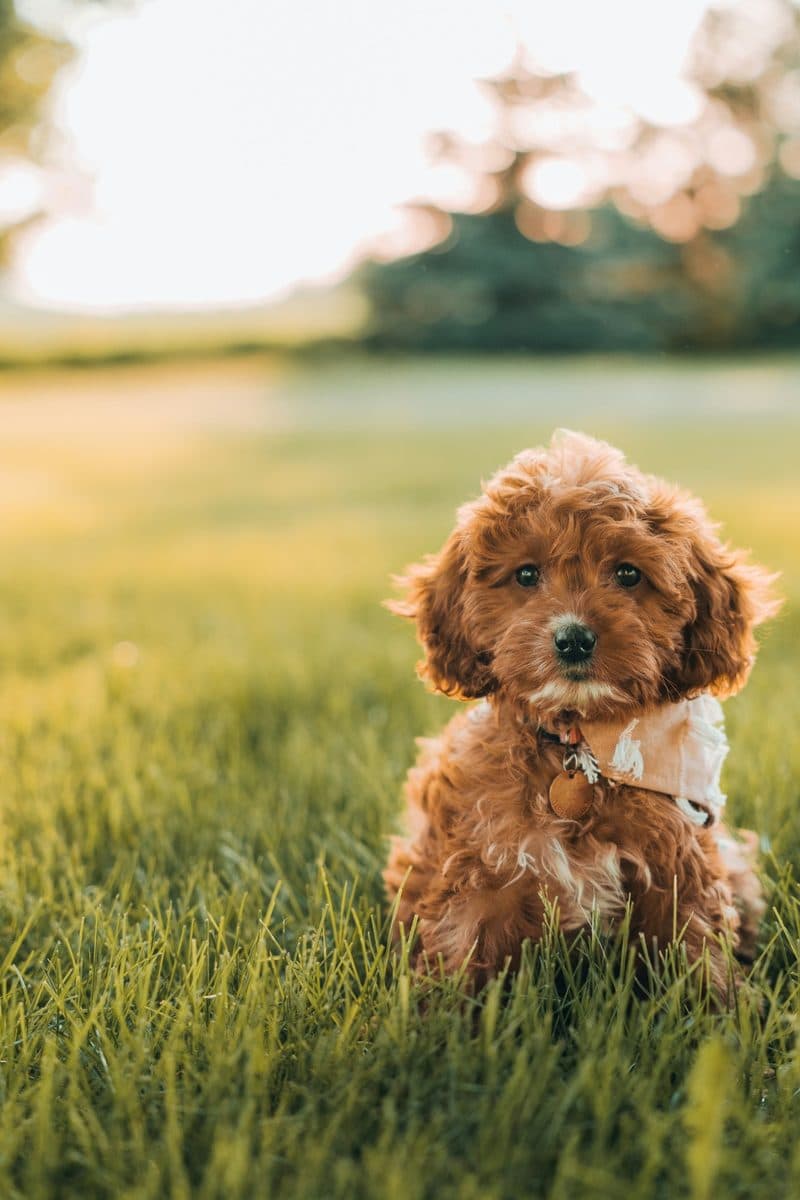
Mini Goldendoodles: how big they get, how much they shed, and what to ask a breeder
“Mini” isn’t a fixed size. How to predict a puppy’s adult size, what the coat will be like, and the health tests to ask for.
Key takeaways
- “Mini” isn’t a fixed size. Most breeders mean roughly 15 to 35 pounds.
- The parents’ weights and past litters predict adult size better than any label.
- Curly coats shed least, but no Goldendoodle is truly hypoallergenic.
- Both parents need their own breed’s health tests.
In this article
A mini Goldendoodle promises the friendly Golden Retriever personality in a dog that fits a smaller home. Many families love them. But “mini” means different things to different breeders, and the size and coat you get depend almost entirely on the parents.
Here’s what a mini Goldendoodle actually is, how to judge how big a puppy will grow, and what to check before you put down a deposit.
What is a mini Goldendoodle?
A mini Goldendoodle is a Goldendoodle bred to be smaller, by using a Miniature Poodle instead of a Standard Poodle. The two parent breeds are very different in size: the AKC lists Golden Retrievers at 55 to 75 pounds and Miniature Poodles at 10 to 15 pounds.
Because of that gap, puppies from a Golden crossed directly with a Miniature Poodle can vary a lot in size. Many breeders of minis instead breed mini Goldendoodles to Miniature Poodles, or mini Goldendoodles to each other over several generations, which makes size and coat more predictable. You’ll see these generations written as:
- F1: a Golden Retriever crossed with a Poodle.
- F1B: an F1 Goldendoodle crossed back to a Poodle. Curly, lower-shedding coats are more likely.
- F2, multigen: Goldendoodles bred to Goldendoodles, sometimes over many generations.
Goldendoodles aren’t recognized by the AKC, so there is no breed standard for size, coat or anything else. Each breeder decides what to call “mini.”
How big do mini Goldendoodles get?
Most breeders use “mini” for adults of roughly 15 to 35 pounds, but there’s no official definition. Some breeders also sell “petite,” “toy” or “micro” Goldendoodles below that, and “medium” ones above it. Doodle breeder associations that publish size categories tend to go by height, since weight changes with diet and age, and the numbers differ from group to group.
The best predictors of your puppy’s adult size are:
- Both parents’ weights and heights. Ask for real numbers, not “mini.”
- What puppies from the same pairing grew to. A breeder who has repeated a pairing can tell you how big past puppies ended up.
- The generation. An F1 from a big Golden and a small Poodle is the hardest to predict.
Be wary of any breeder who guarantees an exact adult weight. A range based on past litters is honest. A promise isn’t.
Do mini Goldendoodles shed? Are they hypoallergenic?
It depends on the coat, not the size. Curly coats, more common in F1B and multigen Doodles, usually shed the least. Wavy coats shed a little, and flat or straight coats can shed much like a Golden Retriever.
No dog is truly hypoallergenic. The proteins that cause allergies come from skin and saliva, not only hair. A low-shedding coat holds on to hair and dander, and many people with mild allergies react less to these dogs, but reactions vary from dog to dog. Spend time with the parents before you commit.
Some breeders DNA test their dogs for coat genes, such as the gene behind the “furnished” Doodle face with a beard and eyebrows. Results can help predict which coats are possible in a litter, but they aren’t a promise about any one puppy. Our guide to low-shedding dog breeds covers the grooming these coats need: brushing several times a week, and a groomer every 6 to 8 weeks.
How long do mini Goldendoodles live?
There isn’t good long-term data on mini Goldendoodles as a group. The AKC lists 10 to 12 years for Golden Retrievers and 10 to 18 years for Poodles. Parents with good health results, and a breeder who knows how long the dogs in their lines have lived, give a puppy the best start.
The health tests both parents should have
A mini Goldendoodle can inherit problems from either side, so each parent needs the tests for its own breed. If a parent is itself a Goldendoodle, it should have the tests for both.
- The Golden Retriever side: hips and elbows (OFA, after age 2), a heart exam, an eye exam by a board-certified veterinary ophthalmologist, and a DNA test for NCL. That’s the Golden Retriever Club of America’s recommended list, as published by the AKC. Many breeders also DNA test for the forms of PRA found in Goldens.
- The Miniature Poodle side: kneecaps (patellas), hips, an eye exam, and a DNA test for PRA-prcd, per the Poodle Club of America’s list.
Ask for each parent’s registered name and look the results up yourself at ofa.org. Our guide to OFA health testing explains what the results mean.
Red flags with mini Goldendoodle breeders
- Puppies sold as “hypoallergenic” or “non-shedding,” or a guaranteed adult weight.
- “Teacup” or “micro” puppies bred for the smallest possible size.
- Health results for only one parent, or only “vet checked” puppies.
- No parent weights, or the parents aren’t on site and the breeder can’t say where they are.
- Several litters always available, or pressure to pay a deposit today.
Our list of questions to ask a dog breeder covers the rest of the conversation, and our puppy scam guide covers fake sellers, which are common for popular Doodles.
Where getabreeder fits
Before a breeder can list on getabreeder, a person on our team checks their photo ID, their kennel registration or license, and the address where their dogs live. Our top verification tier adds the parents’ health clearances, checked against OFA’s public records. Here’s exactly what we check. Our Goldendoodle guide covers generations, temperament and grooming in more detail.
Frequently asked questions
How big do mini Goldendoodles get?
Most breeders use “mini” for adults of roughly 15 to 35 pounds, but there’s no official standard. The best guide is both parents’ weights and what puppies from the same pairing grew to.
How long do mini Goldendoodles live?
There’s no good long-term data on mini Goldendoodles as a group. The AKC lists 10 to 12 years for Golden Retrievers and 10 to 18 years for Poodles.
Do mini Goldendoodles shed?
It depends on the coat, not the size. Curly coats, more common in F1B and multigen Doodles, shed least. Flat or straight coats can shed much like a Golden Retriever.
Are mini Goldendoodles hypoallergenic?
No dog is truly hypoallergenic, because allergens come from skin and saliva, not only hair. A low-shedding mini Goldendoodle may bother you less, so spend time with the parents before you commit.
Looking for a breeder you can trust?
Before a breeder can list on getabreeder, someone on our team checks their ID, their kennel registration or license, and where their dogs live.
Last updated November 18, 2026. General information, not veterinary or legal advice.
Keep reading
Breed guides